where everybody knows your name who cares

One goal of Google and the other IT hegemons, with their wearable interfaces and online glasses and enhanced realities and data-rich maps, is to make it so we are no longer alien anywhere. Thus Michael Jones of Google Maps, interviewed in The Atlantic recently, millenially and yet banally asserted that in the future, your phone or glasses or whatever will just automatically give you directions, no matter where you are, also enriching your every moment with information targetted to your exact spot and behaviorally-determined preferences — eg around which corner is to be found  a great bar, what to order, who else may be there, etc. Jones: “It’ll be like you’re a local everywhere you go.” Around every corner, be it in Beijing or Toronto or Timbuktu, you can find your Cheers.

But clearly: to be a local everywhere is to be a local nowhere. It is to lose all contact with the very notion of locality. The logic here is like the logic of being at home. Suppose that you are in your house. What are you doing? Well, among other things, you’re being at home. Now you look out the window, and see your neighbour inside his house. He is doing what you are doing: you both are being at home. But where he is at home, you would not be at home. Where you are at home, he would not be at home. Only insofar as there is not-being-at-home is there being-at-home. Only insofar as it is possible not to be a local does it matter in the slightest to be a local.

So the Google vision, which seems so light and wondrous, may be quite the opposite.

But nobody notices.

less and less about politics

Philosophical question: how can the Leibniz who denies mind-to-brain reduction  (as in his image of the mill) also be the Leibniz who asserts discourse-to-math reduction? How can he be an anti-reductionist as a philosopher of mind, but a pro-reductionist as a philosopher of language? I don’t get it.

epistemological thought for the day

The very idea of a database seems to me epistemologically questionable. For the idea rests on — or, perhaps, projects — a supposition of data as finite.  For if data is infinite, then the idea of a collection of some data, presumably, is useless and stochastic. It would be like having a collection of some numbers (assuming numbers to be infinite). What’s the point? You might as well have just one — the one you are working with, when you’re trying to work out some problem. For one in the number, compared to infinity, is all you can ever have.

Only if data (in the last analysis) is finite can the idea of a database make any sense. Only if data is finite can the idea of an ever-larger database make sense. Therefore, the more committed one is to the idea of a database, the more committed one becomes to the presupposition that data is finite. In this way, every database, from the Domesday Book to Google, enforces upon us an epistemological assumption. The “bigger” the database, the more powerfully enforced is the assumption.

Do we know this assumption to be correct? Can we? I don’t know (perhaps there is an answer in theoretical physics) but I doubt it. And if not, isn’t it kind of problematic for us as a culture and society to be increasingly committed to the idea of the database? Aren’t we begging the question of what knowledge, fundamentally, is, or might be?

critical-phenomenological thought for the day

Understanding, Hans-Georg Gadamer teaches, is an event. It is an experience (Erfahrung) that we undergo: like the way a player experiences a moment in the game; or an audience member experiences the climax of a tragedy. Indeed, understanding is an experience of a very special kind, which precludes or overwhelms our front-of-mind consciousness. Gadamer points out that the player of a game, in the midst of playing it, knows in one sense “this is only a game.” Yet in another, larger, and more important sense – and this is the key point – s/he does not and cannot know that. For knowing “this is only a game” would preclude or impede effective involvement in the game. Analogously, Gadamer claims, when we are in the midst of understanding something, we know in one sense “I am currently understanding.” Yet in another, larger, and more important sense, we do not and cannot know that. For knowing, in a front-of-mind way, “I am currently understanding” would preclude or impede our being fully involved – lost, for the moment – in the understanding. And getting lost in this way is precisely part and parcel of the kind of experience that understanding is.

Now literary criticism, let’s say, is the study of texts as texts. Understanding is the fulfillment of any text. Therefore, literary criticism includes the study of understanding. (This means, for those who follow this sort of thing, that criticism subsumes hermeneutics.) To study anything is to try to understand it. Therefore, criticism has as one of its goals to understand understanding.

But if understanding is an experience, along the lines already described, then understanding understanding can only mean (1) trying to understand this very special experience and (2) doing so precisley by trying to have this experience. For there would appear to be no other way to do it. The literary-critical classroom, unlike the classrooms of other disciplines, where this or that object is examined, will be a classroom in which the experience of understanding itself is provoked, and for its own sake. The literary text, moreover, unlike texts of other kinds, will not try to present this or that object, but will try to make available the experience of understanding, just as such. Studying such a text, in such a critical mode, will be, if not the only, then probably the best, way to understand understanding.

So, like, that’s why we do it.

on Ratzinger and reading

Another thing I’m not is a theologian. Nonetheless, here’s something I wrote a few years ago on Benedict’s exegesis (his interpretation of the Bible) and hermeneutics (his theory of interpretation generally). Warning: very long and dense.

——————————————————————————————————————————-

Cardinal Joseph Ratzinger, shortly after becoming Pope Benedict XVI, published a book entitled Jesus of Nazareth: From the Baptism in the Jordan to the Transfiguration. Unsurprisingly, for a pontiff who served as doctrinal enforcer for his very conservative predecessor (John Paul II), Benedict seeks in this work to refute liberal theologians, whom he constructs as exegetic sceptics and moral relativists. Against these, Benedict presents his own work as an exegetic objectivism, founded in the stable and self-identical meanings spoken by Christ.

To be sure, Benedict recognizes that interpretative relativism presents a genuine danger for any reader of the New Testament. This is because of the extraordinary readings of the Old Testament offered by the biblical Christ (plus Peter and Paul). The annihilation of the innumerable Jewish laws in the single Christian law of love – coupled with the insistence to be fulfilling Torah complexity thereby, without abrogating “one jot or tittle” – places the Gospel on a paradoxical, even an antinomian, footing.  Mustn’t the law of love have the power to annihilate any and all scriptural injunctions, replacing them with “humanistic” interpretations, as long as the latter appear consistent with the law of love? Doesn’t Christ himself give license for this sort of thing?

Benedict answers very clearly, and very firmly, in the negative. Christ could radically reinterpret scripture, the pontiff writes, solely and precisely because He was the Christ: the Word of God, the incarnation of the Holy Spirit; the scriptural author, in effect, made flesh. Having determined, authorially, the meaning of Torah in the first place, Christ is uniquely and exclusively, empowered to revise its meaning. Thus in examining the relationship between the Mosaic law and Christ’s revisionist treatment of it, we are not exposing ourselves to “the personal opinion of one teacher,” a mere “liberal reform rabbi.” As a matter of fact, Benedict writes,

“Jesus’s teaching is not the product of human learning, of whatever kind. It originates from immediate contact with the Father, from “face-to-face” dialogue – from the vision of the one who rests close to the Father’s heart. It is the Son’s word. Without this inner grounding, his teaching would be pure presumption. That is just what the learned men of Jesus’ time judged it to be, and they did so precisely because they could not accept its inner grounding: seeing and knowing face-to-face.” (Jesus of Nazareth, 7)

The interpretative diktat of the divine author, emanating from a dialogue that is before all dialogue, is the only standard that the Pharisees could have accepted for Jesus’s inversions of Torah. But unbeknownst to them, this is exactly the standard that he (on Benedict’s reading) brought. It is precisely “adherence to Jesus himself, to his Torah” that hermeneutically validates the Gospel: for

“if Jesus is God, then he is entitled and able to handle the Torah as he does. On that condition alone does he have the right to interpret the Mosaic order of divine commands in such a radically new way as only the Law-giver – God himself – can claim to do.” (Jesus of Nazareth, 115 [my emphasis])

It follows that Christ gives Christians (according to Benedict’s argument) no hermeneutic licence at all. He sanctions no new ways of making sense out of scripture. Rather, Christ sanctions new senses of scripture – which he, out of an “original understanding” unique to himself, makes.

To be sure, Christians are called upon to believe that the resulting interpretations of Jewish law are, without any doubt or question, valid (even for Jews). This validity, however, rests only and terminally on its posited origin in Christ. Gospel hermeneutics, for Benedict, devolves on the mystery of the Incarnation. Therefore, for anybody to read the Bible as Christ reads Torah would be blasphemy, not exegesis. It would be tantamount to claiming Christ’s hermeneutic position. Even the Church, despite its traditional claim to be filled by the Holy Spirit, shrinks (in Benedict’s construction) from such an usurpation. In this way, Benedict purchases doctrinal security from exegetic scepticism and moral relativism. The intensionality of Christ, placed before and beyond scripture, controls and determines its meaning absolutely and finally.

But at a very high price. Benedict’s objectivism depends on a posit of incomprehensible validation. Christ’s interpretations, Benedict tells us, are a priori valid; but only Christ can understand that a priori validity. All anybody else can understand, or needs to understand, is that Christ, and Christ alone, understands it. Therefore (1) nobody else should claim or expect to follow, in the last analysis, the hermeneutic logic of Christ’s insights into Torah; and (2) Christ’s power of incomprehensible validation (incomprehensible, that is, to anybody who is not Christ) is his unique and effective exegetic privilege. We must be prepared to accept, precisely without understanding, the posited validity of Christ’s interpretations. Acceptance, for us, must be our exegetic validation; and such validation, by definition, must be incomprehensible.

Achtung: incomprehensible validation, on Benedict’s view, is supposed to be a unique privilege of Christ. Yet in trying not to touch that privilege, we find ourselves taking it up. We find ourselves defining Christ’s hermeneutics by an idea of ours: namely, the idea of a limit to our understanding. We propose that we understand that Christ’s validation is something that we can’t understand. But how can we possibly understand that?

Meanwhile: if we are unable to understand what makes Christ’s interpretations valid, that amounts to saying that we cannot, finally, understand them to be valid. (We can only accept them to be valid; which, etc.) Now, understanding an interpretation means understanding it to be valid or invalid. Understanding an interpretation to be valid is entailed in understanding that valid interpretation. Presumably, Christ gives only valid interpretations (this would appear to be a theological necessity). Therefore, if we cannot understand Christ’s interpretations to be valid, it follows that we simply cannot understand Christ’s interpretations.

But if we cannot understand Christ’s interpretations, we cannot specify what they say or don’t say. For being able to specify that would be understanding them; which, apparently, we cannot do. Now, if we cannot specify what Christ’s interpretations say or don’t say, we surely can claim no grounds for validating or invalidating anybody else’s account of what they say or don’t say. For our account of what the interpretations say or don’t say can make no claim of correctness. All accounts of Christ’s interpretations, therefore – all readings of the Gospel – must be accounted equally valid, and/or invalid. But that amounts to the view that we don’t even know what the Gospel says. This is a position of absolute, even incoherent, exegetic scepticism. But this is what follows from Benedict’s attempt to establish exegetic objectivism.

Finally: Benedict is saying that Christ’s interpretations of Torah are a priori valid. An interpretation of Torah is sound and correct (mutatis mutandis) simply on the basis that Christ gave it.

Now, Christ can, presumably, experience no restriction on his interpretative choices. This would be inconsistent with divine freedom, as well as with the very idea of an interpretation – a selection of textual meanings, out of the range of all possible meanings. Therefore, Christ could have given any number of different interpretations (of a given Torah precept) from the one that he actually gave.

Moreover, the interpretation Christ actually gave is no more intrinsically valid, in and of itself, than any of the other possible interpretations he could have given. The Gospel, in short, could have been different (even though it is not).

Christ could, in principle, enthusiastically have joined in stoning the adultress.

He could have excommunicated himself for healing on the Sabbath.

He could have insisted that his Gentile followers undergo circumcision.

Such possibilities, however, make the Gospel that is – as opposed to the Gosepls that might have been – a mere entry in an illimitable, and effectively random, catalog of potentially-valid religions. But this, again, is exactly the sort of view against which Benedict conceives himself to be polemicizing.

Willy-nilly, Benedict has repeated the error of Plato’s Euthyphro – who thinks that piety is just what is God-beloved, rather than thinking that the gods love what is pious. Such voluntarism evacuates, rather than safeguarding, the ethical content of pious phenomena. They become arbitrary, conventional, from the divine point of view. And the divine point of view is exactly the one that matters.

The way to save exegesis from scepticism, in fact, is not to propose (with the pontiff) that Christ’s interpretations are a priori valid. It is to propose, rather, that Christ gives a priori valid interpretations – but precisely as valid, rather than as arbitrary re-determinations of what counts as valid. They are a challenge for human interpreters, the recipients of the divine to teaching, to understand, with the tools and abilities given to them for that purpose.

Similarly, the way to save the Gospel from relativism is not to point out (with Benedict) that God, freely, has given it. It is to point out, rather, that God has freely given the Gospel – and nothing other than the Gospel —  the truth as the truth, not as one of any number of ways “the truth” could have been. The Gospel, in this manner, is opened up as something that the individual Christian can, and must, try to understand, precisely in the very nature of its challenging validity. And that means, finally, that the hermeneutic keys to the Kingdom cannot be left, pace Benedict, in its ruler’s keep.

Benedict’s exegesis is authoritarian; his hermeneutics, empty. His is a theory of reading as not reading at all. There’s a long tradition, going back at least to Augustine, behind this kind of view. More’s the pity.

If the trumpet give an uncertain sound

I thought it was striking that the President quoted Scripture at the memorial for the Newtown victims on Monday. Traditional Democrat tendencies (at least in recent decades) might have been to shy away from such Christian rhetoric — especially given the “inter-faith” nature of the event. But Obama, by his own account a practicing Christian, spoke from a position of that faith. In my view, this was entirely appropriate. Inter-faith dialogue does not mean that faiths are checked at the door, but rather — exactly to the contrary — that they are welcome to come in as they are. Moreover, if respecting others’ faiths means anything, it means expecting that one’s own faith (or lack thereof) will be respected in the same way. For the whole idea is that each individual’s speaking-position is something she or he can’t just lay aside. Thus Obama, as a Christian, showed maximum respect and humility for the dialogue by speaking Christianly. He would have been condescending and inauthentic — he would have been speaking in bad faith — if he had offered only the usual post-modern and non-sectarian homilies. You know the sort of thing: let’s all come together, rise above our troubles, seek the light, etc.

And yet: I thought the President’s choice of scripture was pretty striking, too. He quoted 2nd Corinthians 4.16-18, in the New International Version (NIV). I did NOT know that just from reading his address; I had to Google the quote, just like everybody else. As a matter of fact, I was initially unsure, despite his “Scripture tells us,” that Obama was quoting the Bible at all. The second letter to the Corinthians is pretty obscure, I think (Biblical scholars are welcome to correct me), lying as it does in the massive rhetorical shadow of First Corinthians (with its through a glass darkly, faith hope charity, etc.). 2.Cor.4.16-18, specifically, is one of the relatively few passages in any of Paul’s Epistles that make no mention of Jesus, or the Church. It is one of the very few in Paul that sound rather like a non-sectarian post-modern homily — a lot of generic stuff about not losing heart, seeking inward renewal, looking to eternity, etc. The incredibly bland prose of the NIV, which would not be out of place in a self-help book, doesn’t help. (Obviously, I’m a King James man myself). Add it all up and you have the President quoting Scripture at the Newtown memorial, but in such a way that he was almost not quoting Scripture. It was as if he was trying to sneak the Bible in; to screen it, rather than to show it.

I think that’s unfortunate. For two reasons. First: the careful choice of such an unscripturey scripture does tend to weaken, along the lines I’ve already indicated, the authenticity and sincerity of Obama’s speech. And second: The President was speaking at the advent of a domestic political crisis that contains within itself the potential for a tremendous social renewal. Across the media and political landscapes of the United States, people who have previously hidden their support for gun control, or have actively campaigned against it, are suddenly and as if through an awakening standing up and saying that the wind has changed. If the President is to lead  on this issue, if he is to seize and augment the progressive momentum that has been unleashed since the Newtown shootings, he will need to be, not just a manager, or a figurehead, or a decision-maker — but a teacher, a father, a preacher. In the idiom of St. Paul, Obama will need to prophesy. And this not in any generic mode, but in a manifestly Christian one.

After all, the gun-madness of contemporary US political culture (like the reactionary-right-wing-madness of which it is a subset), is not a Jewish or a Muslim or an interfaith problem. It is a Christian problem. The politics of firearms extremism in the US is intimately intertwined with the politics of evangelical Christianity, in all its dogmatic self-caricature. The way to cut this knot is not to concede Christianity to ignorant reactionaries, but to reclaim it from them. And although I am not myself a practicing Christian (or anything else), I know enough of the Bible and of Christian tradition to believe quite passionately that such a reclamation is entirely possible. I have always thought it one of the long-term disasters of modern American politics that progressive leaders have abandoned Christianity, which is so deeply-rooted in so many areas of American society, to the reductive right-wing. Less than fifty years ago, it was not so: the civil-rights struggle would never have succeeded without the churches, and the transformative work of Martin Luther King was saturated with the Bible through and through. Obama, perhaps more than any Democrat since King, may have the capacity to re-articulate for Americans the meaning of the Christian testament. And if he doesn’t, I do not believe that he will be able to achieve very much on gun control.

So I hope that Obama will speak to this issue, precisely as a Christian, sincerely, fully, and openly. I hope he comes out swinging, with Jesus and Paul and John. I’m afraid, though, that prophet is a role he does not quite want; that passion threatens his coolness. I’m afraid he will flinch, as he did at Newtown, when asked to speak from his faith.

And then who shall prepare for the battle? (1 Cor. 14.8)

the lost law

[Re-upping this post from a number of years ago. It’s about the US Supreme Court’s disastrous D.C v. Heller judgment re: the US 2nd Amendment. I take the view that the latter does not guarantee a right to private gun ownership, even though it does clearly and explicitly talk about guns, and people owning them. And I still take that view, for the reasons given below.]

In its recent judgment striking down the District of Columbia’s handgun ban (DC v. Heller), the US Supreme Court found that the Second Amendment protects a legislatively inviolable  right of domestic gun ownership. This despite the Amendment’s failure to say so, transparently or self-evidently. It says (precisely, down to the commas):

“A well-regulated Militia, being necessary to the security of a free State, the right of the people to keep and bear Arms, shall not be infringed.”

Justice John Paul Stevens, dissenting in Heller, notes that the Amendment subordinates the question of gun ownership to a question of militia regulation. He also notes that some contemporary and analogous state laws, and some rejected proposals for the wording of the Second Amendment itself, carefully and explicitly mention and protect private gun ownership for domestic and non-military purposes (such as hunting and self-defense). In other words, the extension of the “right to bear arms” beyond the area of militia organization precisely did not go without saying, in the founding period. Yet this very extension is exactly what the Second Amendment fails to provide.

To be sure, it does not follow from the Second Amendment’s ambiguity, or from the militia subordination, that the Amendment constitutionally invalidates domestic gun ownership. It does follow, however, that the Amendment does not constitutionally necessitate domestic gun ownership. As Justice Breyer argues in his own dissent, the Amendment simply does not rise to the standard of explicitness and unequivocality that is necessary to the extraordinary circumstances of judicial review – when judges, unelected, and (on most questions) empirically non-expert, strike down statutes that express the democratic will of the people, as codified by their elected representatives, after consideration and application of the available evidence.

Interestingly, the attitude that Breyer asserts – judicial circumspection, founded on a reflexive scepticism about his own insight, and a keenness to respect the constitutional separation of powers – is itself usually asserted by conservative judges like those who formed the majority in Heller. Yet in Heller, the Court’s originalist majority sees fit to strike down the DC handgun law: to find, that is, that the justices know a priori what are the limits of acceptable gun control, because of what the Second Amendment, allegedly, means.

And what, on the originalist reading, does it mean? Justice Antonin Scalia, writing for the majority, argues as follows. Scalia proposes that the Amendment’s two clauses – the “Militia” clause and the “bear Arms” clause – need to be read in reverse order. As Stevens comments, understatingly, “that is not how this Court ordinarily reads such texts.” It seems a very unusual way for anybody to read any text – especially a complex sentence, in which a dependent clause leads into, and in some sense determines, an independent one. However, Scalia justifies his move by asserting that the syntax of the Second Amendment allows, even dictates, its own reversal. The militia clause, he says, is “prefatory.” The bear arms clause is “operative.” “A prefatory clause,” he writes, “does not limit or expand the scope of the operative clause”; “the former does not limit the latter grammatically, but rather announces a purpose.” Scalia’s hermeneutic redistribution of the Amendment depends, evidently, on his grammatical talk of “prefatory” and “operative” – as opposed to,  say, “dependent” and “independent,” or even “first” and “second” – clauses. For this talk is what allows Scalia to assert that the “bear Arms” clause is the one that basically matters, being “operative”; while the “Militia” clause, being merely “prefatory,”  is only there to lead into the “bear Arms” clause.

No doubt there are complex sentences in which the dependent clause can accurately be called “prefatory” to the independent  one, rendering the latter solely “operative.” (E.g.: “As he walks up the street, shoot him”). Equally, however, there are certainly complex sentences in which the dependent clause semantically determines – limits or expands or redirects – the extension of the independent one. (E.g.: “If  he walks up the street, shoot him”). In the first case, one might be able to parse the second clause first. In the second case, one certainly could not.

It is far from clear that the Second Amendment is closer to the first kind of complex sentence than it is to the second. The question of whether it is, moreover, is nothing other than the question of whether or not the Second Amendment, prima facie, seems to enshrine a constitutional right to domestic gun ownership. For if the Amendment’s syntax really breaks down into “prefatory” and “operative” clauses, then (as we have seen) the “bear Arms” clause will seem to be the one that really matters, being “operative.” If, on the other hand, the bear arms clause is not the one that really matters, then the militia clause cannot hardly classified as merely “prefatory.”

The point here is that Scalia’s basic reading of the Amendment, and the pseudo-grammatical binary he invokes in order to ground that reading, are one. They are twin iterations of Scalia’s sense of the Second Amendment’s “original understanding” as having to do with the armed defense of “hearth and home.” One iteration appears as reading; the other as the rule that allows that reading. Scalia’s “original understanding” of the Amendment is a pre-interpretative intension that he “discovers” by a method that is projected by that very (alleged) discovery. This is a classically objectivist circularity.  The “original understanding” is projected before constitutional interpretation, and even before the constitutional text. It therefore allows Scalia to determine the latter, and dismiss the former.

Chaos, Control, Centrifuge

Three thoughts on Paris, from which I have recently returned. 

1. Chaos      Paris escaped the Second World War with very little damage. The French capitulation of 1940 spared the city a German attack; the German tactical retreat of 1944 spared it an Allied one. Neither side, at any time, had much reason to bomb it. This historical blessing is not only on the great monuments of the Right Bank, but also on the medieval squalor of the Left (where I stayed for the first part of my trip). The neighborhoods that spread southward from l’Ile de la Cité present a real, organic continuity with the way they they would have been a thousand years ago. On the narrow, irregular streets, you wander and backtrack and go in circles and get lost in a way that is utterly different from the right-angled consciousness of a modern city. True, few of the buildings are medieval — but most of them are pretty darned old, dating, I would guess, from the 16th and 17th centuries. (Compare the City of London: medieval street scheme lined with International Style banks.) The bulges and leans and angles, to somebody raised in an earthquake zone, border on the terrifying. My tiny hotel had exposed, rough-cut timbers, stuck in the plaster walls like sausages in cream; and a central supporting post, the stairwell curling around it, so roughly-finished and glossy with age that I think it was last a tree around the time Champlain founded Quebec. (That’s like Jamestown colony, y’all.) Even in Rome, I don’t know if you would find many structures like that, still standing and functioning in the heart of the city. So Paris, despite its size, bustle, and sophistication, still retains and offers a remarkably satisfactory impression of The Medieval City. Earthiness and all. On my first night there, approaching Nôtre Dame from the south, openmouthed in awe at its High Gothic perfection, I was meditating on how wonderful it is that such a cathedral stands alone on the end of an island, because that means you can see it as a whole from a distance, which is very rarely the case with the major church buildings from that era (nestled as they usually are in a dense urban fabric), and I was transfixed by the immense rose window in the southern elevation, folding and unfolding eternity across the Seine, like a vision out of Hieronymous Bosch, like the eye of God as painted by Dalí, when I stepped straight into a huge pile of Parisian dogshit. The only time in my life, I’m pretty sure, when this kind of mishap has made me laugh.

2. Control     Of course, there’s also a modern Paris – some of which, paradoxically, isn’t really in Paris (and I’ll come back to that) – and nothing could be more modern than the main François Mittérand site of the Bibliothèque Nationale. (Disclosure: NOT my pictures.) Walking east along the Seine, you first encounter this building as stairs leading up from the street: high, precise, wooden stairs, stretching the length of the block and beyond, steep enough and tall enough that they almost seem to lead nowhere. Climbing them, you find yourself on a massive rectangular plaza, at each corner of which stands a twenty-storey L-shaped office tower with a curtain wall of green glass – ultra-minimalist, huge, and showing very little sign of human activity. So it’s monumentality and simplicity to the NNNth degree. And the initial impression, at least for me, is of one too many degrees.
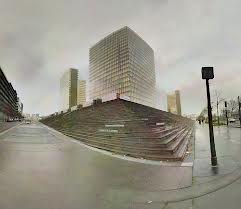
To access the library, you have to re-descend. This needless complication and redundancy of movement – going up to go down – is all the more annoying for being dressed up in an aesthetic of ultra-modern simplicity and functionality. There are two entrances, east and west, down moving sidewalks (why these should be necessary I have no idea) between jutting steel walls. At the bottom is a little cantilevered concrete patio, as cramped as the plaza above is massive, which tends to become a horrendous smoke pit, because the French still puff like crazy (but have banned it indoors), and people naturally stop there when they exit the library, rather than purposefully going all the way back up to the plaza. So that vast public space up there sits empty – not openness, but vacancy – and you eat smoke like a firefighter as you go through the revolving door.

When you enter the buiding, your briefcase is searched, and you pass through a metal detector. Then it is mandatory that you check the briefcase, receiving instead a clear plastic mallette. That means “briefcase.” So you have swappped your case for a case. What is more, at this stage nobody cares what you transfer from the one to the other. Your briefcase got checked at the entrance to the building; but nobody even looks at your mallette when you enter the actual research libary. The only point of the procedure seems to be the procedure.

To get into the actual library, you first scan your researcher’s card to pass through a turnstile – “exactement comme dans le Métro,” as the cheerful, Kindergarten-teachery lady who gave me my researcher’s card explained. (I was grateful for her slow, clear French, and for how she helped me not to miss Maman.) Then you go through two sets of floor-to-ceiling grey metal doors, and then down a very long escalator. At the bottom, you are in a vast, open, cold, concrete entry hall, two stories high. It’s like what every Brutalist architect with a public commission in the 1970s wanted to build, but didn’t  quite have the budget for. Before passing through another set of giant metal doors – which will finally, more or less, let you into the library proper – you pass through another turnstile, and go to the entry  desk, where a staff member places your card on a special scanner.

Everything at the BNF works through cards and scanners. If you want to use one of the computer terminals: card on scanner. Microfilm: card on scanner. Exit: card on scanner mais SORTIE INTERDITE! If you have documents checked out to your table, and you have not told staff that you are going outside, well, you can’t. The turnstile locks, and you are caught comme un poisson. You have to slink back and ask permission. (Like, I’ve heard.) And even if you don’t have documents checked out, you aren’t really supposed just to leave the research level, just cause you want to, like it’s no big deal.  No: first scan your card at one of the special terminals that are placed at the bottom of the escalator for this exclusive purpose, and only then may you make your way, temporarily, up into the air.

At the entry desk, via the scanner, you are assigned a numbered table in one of the library’s ten main salles de recherche. These are identified by letter and colour, and each one is dedicated to a certain area of research: literature, philosophy, history, and so on. But it doesn’t actually matter which room you end up in; as my Kindergarten lady explained, materials from any of the library’s stacks can be called up to any desk, anywhere.  So it’s another case of superficially important control serving no actual purpose. The same goes for the “clubs” that are situated at the research level’s corners. These are breakout rooms where you can rest, eat your lunch – if you have brought it down with your in your dorky mallette – or get a coffee from one of the coin-operated, twentieth-century-style machines. One is called the “Club des Lois,” another the “Club des Nombres,” another the “Club des Temps,” and the last the “Club des Lettres.” (The towers that stand high above each of them are also so designated.) So, formally, if you’re a number, for example, you know where you are supposed to go to hang out. But substantively, most people go to the Club des Lettres, because that’s the only one with a cafeteria.

My mission at the BNF was to look at a couple of sixteenth-century books with relevance to my ongoing professional interest in the cultural origins of modern information theory (blah blah and blah.) So I asked for, and was assigned, a table in Salle R (histoire et philosophie des sciences).  I found my spot, connected my Ethernet cable – no weefee – and prepared to request my first book. But then things got complicated. There I was, in a surely appropriate salle, trying to figure out how to get the book I wanted on my table. But its citation in the online library catalogue indicated that the book, published in 1564, was actually available on open shelf access – this made no sense – in another place. So I asked a librarian, who informed me

(1) that the history-of-science-related book I wanted could not actually be read in the history-of-science reading room;

(2) that the book was not on open access, but in the rare books room (now that made sense) – even though the catalogue citation gave absolutely no such indication or direction; and

(3) that that meant I was going to have to leave my place in Salle R (where I was just beginning to feel at home) and betake myself to Salle Y.

Where was Sal Eegrek? A difficult question, since the lettered and colored reading rooms, among which I had been invited to request a place, went only up to “T.” (And this even though I had told my Kindergarten lady that I intended to work on livres rares. Maybe she was trying to give me a complex.) Moreover, my helpful librarian, as he tried to get his rather complicated message through my mediocre French comprehension, kept pointing up. Now, rule one at the BNF is the distinction between Haute-de-Jardin – the upper or “studies” level, which is for students and, well, just anybody – and Rez-de-Jardin, the lower or “research” level, which you can reach only by the complex process of application and descent that I have in part described. How could the rare books room – which, frankly, I thought was the whole point of a research library – be up amongst the just-anybodys? Well, it turns out that Salle Y is indeed part of the research level, but only because it is accessed exclusively by a little elevator (I am not making this up), ascending from an anteroom on the other side of another set of giant metal doors located in Salle T! It was at this point that I began to think of Frazier, specifically of the episode where Frazier and Niles keep trying to get to the next level in a chi-chi spa.

In the rare books room, I was able to do some actual research. Also, I learned the real point of the mallette: it is there to get checked, in a little cubby, for which you get a little key. It’s disappointing that there isn’t another room – as far as I am aware – into which you’re not allowed to take that key.

After I had finished with my first book, I requested another, but was told that I couldn’t have it, because another edition of that book was available on microfilm. The librarian was doing her job – I had to respect that. Well, then, I asked, could I please have that microfilm? “Ah, non, Monsieur,” she replied. “Il faut rentrer a Salle R.”

3. Centrifuge    On the first morning of the conference that had brought me to Paris, I was standing on a Metro platform. A train pulled in, packed to the gills. Not much of a report. But what made it interesting was that the station was on the northern fringe of Paris, and I was heading yet farther north, to just outside the city. In most cities that I have known, the morning rush heads in, not out. But then I was reminded that Paris is surrounded by a thick periphery of offices, universities, ministries, and industrial parks – its major administrative and economic functions, in other words, relegated to les banlieues.  In the morning, Parisians with good jobs head out to do them, in neighborhoods where black and Arab youths burn cars at night. But by then, the Parisians with good jobs are back home, among their elegant boulevards and handsome nineteenth-century apartment buildings, in the numbered arrondissements of the city proper.

Thus the extraordinary, almost miraculous beauty of central Paris – a city full of museums, which is itself one – is a bit of a cheat. It is not true, though it may seem so, that Paris has no parking lots, or soulless factories, or faceless skyscrapers. Rather, Paris has those functions, but segregates them outside its own borders, where Parisians propre don’t have to live with them. It’s striking that the arrondissements, numbered from a starting-point at L’Ile de la Cité, radiate outwards in a swirl: a centrifugal shape, which is as if fulfilled in the relationship between the city centre and its perimeter. Paris, like a spinning wheel, throws what is not Paris outward. But how long, driving such a gyre, can the centre hold?

let them eat brains

Great editorial in the still-un-paywalled NP on the real case for Obama. I even agree that the Mittster would not be a terrible President — but I think the GOP as it currently stands would guarantee a terrible Presidency, and I think it crucial that Romney lose, so that the Michelle Bachmans and Karl Roves of the party can annihilate each other in the subsequent internal zombie war.

mine, all mine

Excellent analysis from the Big Red E on the growth of income inequality. The question: is it a problem? The answer: yes, but also, consider the details. I particularly like the point about mortgage interest rate reduction being, in effect, a subsidy to the well-off. The model solution: Teddy Rooseveltian mitigation through liberation. Nice point that it is precisely closed corporate shops, intimately interrelated with anti-entrepreneurial governments,  that have produced the world’s greasiest oligarchs, from Mexico to China to Russia.

a scripture for nine eleven eleven

I always thought this passage uniquely appropriate to the memorial of this day. I’ve emended the translation of KJV below in one significant respect, which afficionados of Biblical philology and seventeenth-century English politics will recognize.

1 Corinthians 13

1 Though I speak with the tongues of men and of angels, and have not love, I am become as sounding brass, or a tinkling cymbal.

And though I have the gift of prophecy, and understand all mysteries, and all knowledge; and though I have all faith, so that I could remove mountains, and have not love, I am nothing.

And though I bestow all my goods to feed the poor, and though I give my body to be burned, and have not love, it profiteth me nothing.

4   Love suffereth long, and is kind; love envieth not; love vaunteth not itself, is not puffed up,

Doth not behave itself unseemly, seeketh not her own, is not easily provoked, thinketh no evil;

Rejoiceth not in iniquity, but rejoiceth in the truth;

Beareth all things, believeth all things, hopeth all things, endureth all things.

8 Love never faileth: but whether there be prophecies, they shall fail; whether there be tongues, they shall cease; whether there be knowledge, it shall vanish away.

For we know in part, and we prophesy in part.

10 But when that which is perfect is come, then that which is in part shall be done away.

11 When I was a child, I spake as a child, I understood as a child, I thought as a child: but when I became a man, I put away childish things.

12 For now we see through a glass, darkly; but then face to face: now I know in part; but then shall I know even as also I am known.

13 And now abideth faith, hope, love, these three; but the greatest of these is love.

squatsch

Seems the Cameron-Cleggers have moved to end the tradition of squatters’ rights that has long been such a feature of the British urban scene. The end of an era – with roots, I had always thought, way back in Common Law. You could probably sink a cruise ship with the number of creative and free-spirited people who have passed through the squats of London at one time or another. However:

Thirteen years ago, while still a graduate student, I stayed for some days in a squat in Hackney, near London Fields. Friends of a friend. The guy had dropped out of architecture school because he felt the hours were too long. He worked, when he wanted to, whitewashing exhibit spaces at the British Museum. His girlfriend was a primary school teacher. The squat was filthy and fetid. I slept in a room full of garbage. Others in the adjoining houses were photographers with expensive equipment, musicians, etc. They seemed to resent me for not buying them wine. All were white, young, middle-class, and able-bodied. They spent most of their time drinking, smoking dope, planning their next drive to the country, complaining about the “yuppies” who had bought the property behind them and, disgustingly, built a studio in the garden; and deciding which of the local restaurants run by thrifty busy non-white immigrants (Vietnamese, around there, mostly) they would patronize for their next dinner. The ex-architect student, who had one of the plummiest accents I ever heard, was petitioning Hackney council to deed the houses to the group, on the understanding that they would fix them up; for which, he further was petitioning, they should all be paid a “living wage.” With benefits and holiday, I guess.

In short: when I left that place, I also checked out of my own earlier sojourn in North London bohemia (1988-90) – finally, gratefully, and once and for all. I understand and applaud that people want to live their own lives. And there are people who have sunk so low they need a place to land. But that’s why we need sound and rational social programs — not crime. Which is what taking other people’s stuff, without permission and for nothing, is. I’m afraid I can’t shed much of a tear over the legal demise of the Squatter’s Raj.

blessings for Obama

This blog post from a conservative pro-life American mother (who “lost her fear of universal health care” after living for some years in Canada) is one of the most moving, useful, frank, intelligent, honest, uplifting things I have ever read about the strengths of our system, and the paranoias of contemporary American culture. About all she doesn’t say is “God bless President Obama for giving all Americans the opportunity for at least minimal medical coverage.”

an Ernie a day

I see in the paper today that Vic Toews is now taking credit for the low crime rate, even though it was steadily lowering long before he started getting all “tough on crime” in the pokerfacedly moronic, US Republican, fucking-pigs-cause-its-what-we-do kind of way. It’s Ernie logic, as in the classic Sesame Street exchange:

BERT. Ernie, why do eat so many apples?

ERNIE. To keep the tigers away, Bert.

BERT. But Ernie, there isn’t a tiger within 50 miles of here!

ERNIE. See? It works!

I wonder how much longer Harper will keep that idiot around.